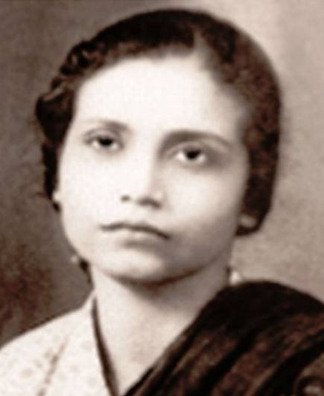
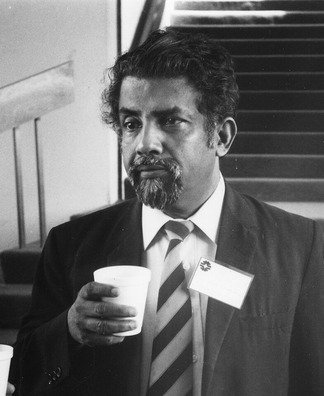
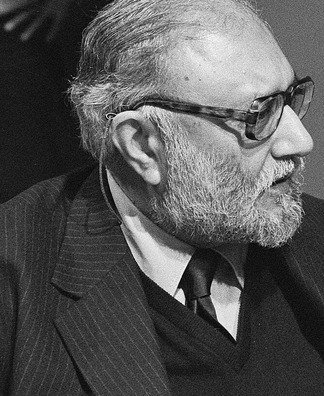
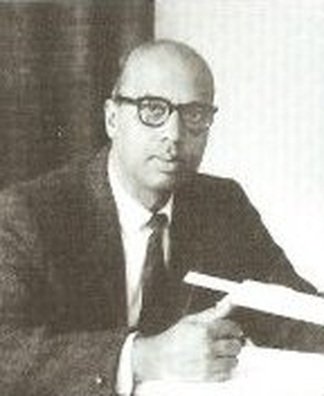
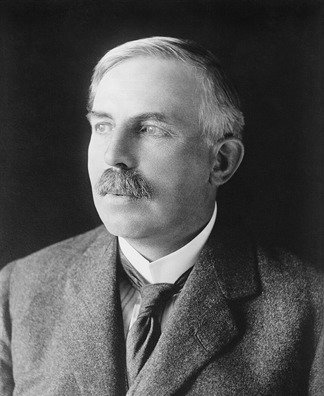
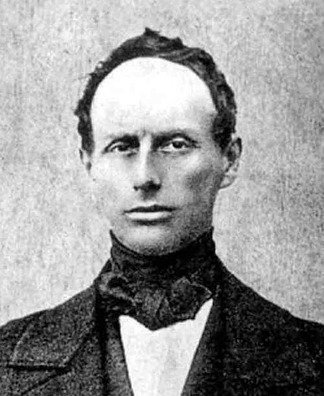
30 physicists who worked without a laboratory, a degree, a post, or the credit. What is here is what they actually did — the year, the job, the apparatus, the letter — and their own words where we could verify them. Where a famous version of a story turns out to be embroidered, that is said too.
Every story links to the chapter its physics lives in, so you can read the result the same evening. Free, all of it.
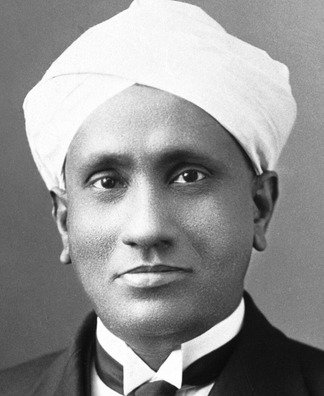
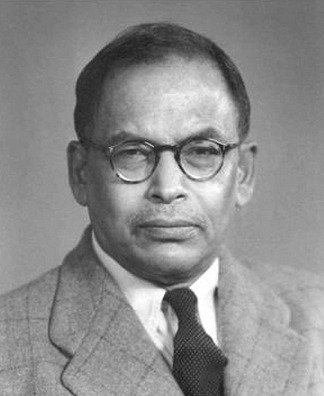
Raman finished his MA in Madras in 1907 with the best marks of his year. There was almost no research post in India for him to go to, and poor health ruled out the usual route of studying in England, so he sat the Financial Civil Service examination, came first in it, and at nineteen was posted to Calcutta as Assistant Accountant General. His days now belonged to the government's books.
In Calcutta he found the Indian Association for the Cultivation of Science, founded thirty years earlier by a doctor who wanted Indians doing research of their own, its laboratory barely used. He asked for a bench. For the next ten years he audited accounts by day and experimented in the evenings and often through the night, publishing as he went, much of it on the physics of vibrating strings and drums. In 1917 the University of Calcutta offered him its new Palit Professorship. It paid less than the civil service. He resigned and took it.
On a voyage to England in 1921 he looked at the blue of the Mediterranean and doubted the textbook explanation that the sea merely reflects the sky. Molecular scattering of light took him seven more years. On 28 February 1928, working with K. S. Krishnan on light passed through liquids, he found a faint second line in the scattered spectrum — light emerging at a different wavelength from the light that went in, because photons had traded energy with the molecules they met.
The Nobel Prize came in 1930, two years after the observation, and was the first won by an Indian in any science. 28 February is now National Science Day in India.
“Ask the right questions, and nature will open the doors to her secrets.”
What you will hear that is not true
You will read that the discovery cost 200 rupees of apparatus. The historian Rajinder Singh has traced that figure to newspaper interviews in the 1940s and to memoirs by Raman's own students — Raman repeated it himself, while also complaining in writing that Indian laboratories were badly equipped. What he actually used was a quartz spectrograph of his own design with a filtered mercury lamp. The story is better without the price tag.
He did not wait for a laboratory of his own. He asked for a bench in somebody else's.
02
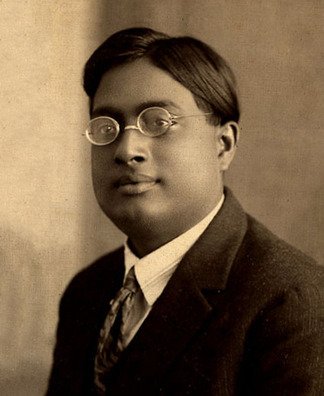
Satyendra Nath Bose
1894–1974 · Dacca
His paper was rejected after six months. He posted it to Einstein instead.
Bose graduated in Calcutta alongside Meghnad Saha, in a generation with almost no access to the European journals it needed and no laboratory worth the name. The two of them taught themselves enough German and French to read the papers, and produced the first English translation of Einstein's relativity work. By 1923 Bose was a reader in physics at Dacca, in a department he described in a letter as neglected: prisms and eyepieces loose on the tables, journals unavailable.
Preparing a lecture on Planck's radiation law, he decided the standard derivation was unsound, because it used classical electrodynamics to reach a quantum result. So he counted differently — photons as indistinguishable from one another, phase space divided into cells of volume h3 — and Planck's formula fell out of the counting alone. He sent the paper to the Philosophical Magazine in London. Six months later the referees' reports came back negative and it was rejected.
Bose did not water it down and try somewhere safer. On 4 June 1924 he posted the rejected manuscript to Albert Einstein in Berlin, with a covering letter asking him to read it and, if he thought it worth publishing, to arrange that himself. Einstein read it, translated it into German, and sent it to Zeitschrift für Physik, where it appeared within weeks. His postcard back to Dacca was dated 2 July.
Einstein then applied Bose's way of counting to atoms instead of photons, and predicted the condensate that now carries both their names; it was finally made in a laboratory in 1995. Every particle that obeys the statistics is called a boson. Bose himself never won a Nobel Prize.
“I have ventured to send you the accompanying article for your perusal and opinion.”
“It signifies an important step forward and pleases me very much.”
A referee rejected the paper. The physics in it was unaffected.
03
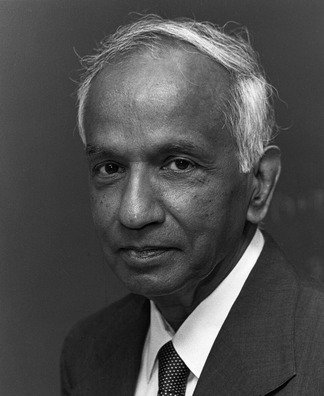
Subrahmanyan Chandrasekhar
1910–1995 · Madras · Cambridge · Chicago
The most famous astronomer alive called his result absurd. It took forty-eight years and a Nobel Prize to settle it.
Chandrasekhar grew up in Madras in a house where physics was close at hand: C. V. Raman was his uncle. In 1930, aged nineteen, on the boat from Madras to Cambridge, he worked out what happens inside a dead star whose electrons are packed so tightly that they move close to the speed of light. Putting special relativity into the degenerate electron gas changes the way its pressure grows with density, and that change puts a ceiling on the whole star: above about 1.4 solar masses, electron pressure cannot hold it up at all.
He published the outline in 1931 and spent four more years on the complete solution. On 11 January 1935 he presented it to the Royal Astronomical Society at Burlington House. Arthur Eddington, the most eminent astrophysicist alive, had encouraged him to speak — and had booked the talk immediately after his without telling him what was in it. Eddington stood up and dismissed the result as physically meaningless. Chandrasekhar asked the chairman for a right of reply and was refused.
Physicists who knew the quantum mechanics was sound, Bohr and Pauli among them, did not say so in public; astronomy was not a field they wanted a fight in. Chandrasekhar left England for Chicago in 1937, wrote the stellar-structure book that trained the next generation, and moved to a different subject roughly every decade for the rest of his life.
Neutron stars and black holes were found in the 1960s and early 1970s — exactly the fates his ceiling required. The Nobel Prize came in 1983, forty-eight years after that meeting.
“…I had no chance even to reply, and had to accept the pitiful glances of the audience.”
“There should be a law of nature to prevent a star from behaving in this absurd way!”
The room was wrong for forty-eight years. The calculation was never wrong for a day.
04
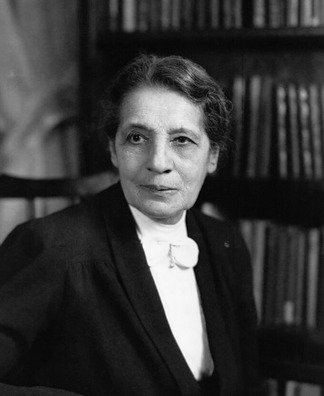
Lise Meitner
1878–1968 · Vienna · Berlin · Stockholm
She fled Germany with one suitcase, then explained fission by post — and her name was left off the paper.
Driven out by lawLeft off the paperNo NobelVI · Nuclei →
Meitner took her doctorate in Vienna in 1906, only the second woman there to be given one in physics, and moved to Berlin to work with the chemist Otto Hahn. Women were not admitted to the institute, so for her first years she worked in a converted carpenter's workshop with its own outside entrance, was not allowed upstairs where the men worked, and was paid nothing at all. She stayed thirty years and ended up leading the physics section of the Kaiser Wilhelm Institute for Chemistry.
After 1933 antisemitic laws pushed Jewish academics out of German institutions; her Austrian citizenship protected her until Germany annexed Austria in March 1938. That July, aged 59, she was taken across the Dutch border by the physicist Dirk Coster with one small suitcase and ten marks in her purse. She never worked in Germany again.
From Sweden she kept working by letter. In December Hahn wrote that bombarding uranium with neutrons was producing barium — an element little more than half uranium's mass, which no theory of the time permitted. Over Christmas, walking in the woods near Kungälv with her nephew Otto Frisch, she sat down on a tree trunk and did the arithmetic on a scrap of paper. The nucleus was splitting in two, and the mass that had gone missing matched the energy released by E = mc2. They named the process fission.
Hahn published the chemistry in January 1939 without her name on it. Meitner and Frisch published the physical interpretation in Nature the month after. The 1944 Nobel Prize in Chemistry went to Hahn alone, and Meitner never received one. Element 109 is called meitnerium.
“I love physics with all my heart. I can hardly imagine it not being part of my life.”
Exiled, uncredited, and still the first person alive to understand what had happened.
05
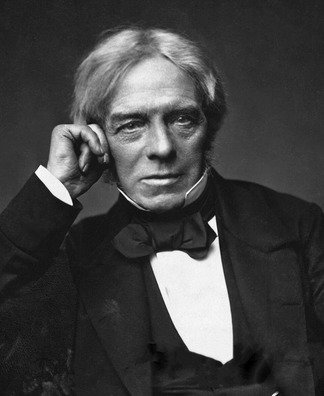
Michael Faraday
1791–1867 · London
A bookbinder's apprentice with no schooling, hired to clean the glassware, who found induction.
Faraday left school able to read, write and do arithmetic, and nothing more. The family was poor — his father was a blacksmith, often too ill to work — and Michael was delivering newspapers at thirteen and apprenticed to a London bookbinder at fourteen. He read the books that passed through his hands, an encyclopaedia article on electricity and Jane Marcet's Conversations on Chemistry among them, and spent his own small wages on apparatus to repeat what he had read.
In 1812 a customer of the shop gave him tickets to four lectures by Humphry Davy at the Royal Institution. He took careful notes, bound them into a book himself, and sent it to Davy asking for scientific work of any kind. He had already written to the President of the Royal Society and received no reply at all. Davy answered him. When the laboratory assistant was dismissed some months later, Faraday was offered the post: washing bottles, sweeping floors, lighting fires, for less than he had earned as a binder. He took it.
He never learned much mathematics, and thought in lines of force instead. In 1821 he made a wire turn continuously around a magnet — the first electric motor. In 1831 he found that a changing magnetic field drives a current in a nearby circuit, which is the sentence every transformer, generator and induction motor has run on since. Maxwell, who turned it into equations, said plainly that the physics was already Faraday's.
He refused a knighthood, twice refused the presidency of the Royal Society, and gave Christmas lectures for children at the Royal Institution instead. The unit of capacitance is the farad.
“My education was of the most ordinary description, consisting of little more than the rudiments of reading, writing, and arithmetic.”
“Nothing is too wonderful to be true, if it be consistent with the laws of nature.”
He was hired to clean the glassware. The law of induction carries his name.
06
Meghnad Saha
1893–1956 · Seoratali · Allahabad · Calcutta
Thrown out of school for joining a boycott, stripped of his scholarship, and kept out of the hostel dining hall for his caste.
A grocer’s son, not meant to be schooledExpelled, and his scholarship withdrawnBarred from the dining hallVI · Atoms →
Saha was born in 1893 in Seoratali, a village in the Dhaka district, the fifth of eight children of a small grocer. There was no free schooling and his father saw little reason to spend money on it; an elder brother argued for him, and a sponsor near the middle school took him in so that he could attend at all. He reached the Dhaka Collegiate School on a scholarship and lost it in 1905, expelled for joining a boycott of a visiting British governor during the Swadeshi agitation. He took his school certificate at Dhaka College instead.
At Presidency College in Calcutta he sat in one of the strongest classes Indian science has produced — S. N. Bose and P. C. Mahalanobis were in it, and Jagadish Chandra Bose and Prafulla Chandra Ray were teaching. He lived at the Eden Hindu Hostel, where students objected to eating in the same hall as him because his family was Shudra, and where he was stopped from making an offering to Saraswati. In 1920, at twenty-six, he published the theory of thermal ionisation: at a given temperature and pressure a calculable fraction of the atoms in a gas have lost an electron, which turns the lines in a star’s spectrum into a thermometer. Every stellar temperature scale still rests on it.
The Royal Society elected him in 1927. He was professor at Allahabad from 1923 to 1938 and then at Calcutta until his death, and he spent the second half of his life building what he had not had: the physics department at Allahabad, the journal Science and Culture, the Indian Physical Society, the nuclear physics institute in Calcutta that now carries his name, and the original plan for the Damodar Valley project. He was elected to the Lok Sabha in 1951 and died in 1956.
Said of them — no quotation of their own is verified
“…some students objected to eating in the same dining hall with him because of his caste status.”
Five years later, at Harvard, Cecilia Payne-Gaposchkin applied this ionisation theory to a drawer of photographic plates and got the composition of the stars out of it. Read Cecilia Payne-Gaposchkin →
The equation that reads a star’s temperature was written by a man barred from a dining hall.
07
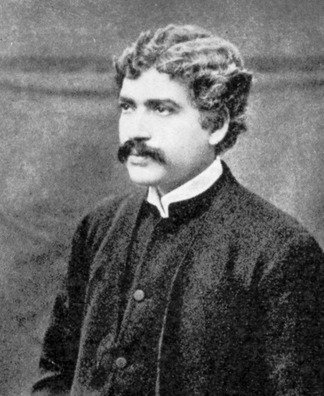
Jagadish Chandra Bose
1858–1937 · Mymensingh · Calcutta · London
Appointed at a third of what a European in the same post was paid, he taught for three years without cashing a single cheque.
Bose read natural sciences at Christ’s College, Cambridge, and returned in 1885 to a physics post at Presidency College, Calcutta. The appointment carried a condition. An Indian in the provincial education service drew two-thirds of a European’s salary for the same work, and because his post was designated officiating, that two-thirds was halved again. He was doing a full professor’s job for about a third of a European professor’s pay. He protested; the protest was refused; so he went on teaching and simply did not cash his salary cheques. He did that for three years, until the college gave way, made the appointment permanent and paid the arrears in full.
He had no laboratory worth the name and built his own apparatus. Between 1894 and 1900 he generated and detected electromagnetic waves at millimetre wavelengths, around 60 GHz — far shorter than anything Hertz or Marconi was working with — using a galena crystal contact as the detector, an early form of the semiconductor point-contact rectifier. In 1895, at Calcutta Town Hall, he sent a signal through walls across seventy-five feet to ring a bell and fire a small charge. In 1897 he demonstrated the work at the Royal Institution in London, on the platform Faraday had built.
He declined to patent nearly all of it, holding that knowledge should not be owned; a colleague’s insistence produced one American patent, which he then neglected. He turned to plants, built instruments fine enough to record their growth and their electrical response to being touched, burned or drugged, and argued that the boundary between living and non-living response was not where physiology had drawn it. In 1917 he founded the Bose Institute on his own birthday and gave it to the country.
“I dedicate today this Institute — not merely a Laboratory but a Temple.”
What you will hear that is not true
He is often called the real inventor of radio, with Marconi cast as a thief. The millimetre-wave work of the 1890s did come first, and the 1904 American patent on a galena detector is real. What has never been shown from documents is a line running from his apparatus to Marconi’s — the claim is asserted far more often than it is demonstrated, and his actual priority is impressive enough without it.
He would not cash the cheques and he would not take the patents. He kept the physics.
08
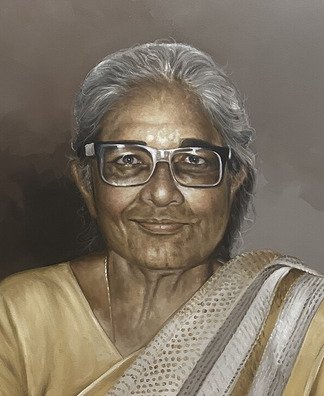
Anna Mani
1918–2001 · Travancore · Madras · Bangalore · Pune
She published five single-author papers under Raman and was refused a doctorate because she held no master’s degree in physics.
Mani was born in 1918 into a prosperous Travancore family of the kind the historian Abha Sur describes as grooming its sons for high-level careers and priming its daughters for marriage. She spent her childhood reading instead, took an honours degree in physics and chemistry at Presidency College in Madras, and in 1940 went to the Indian Institute of Science in Bangalore to work under C. V. Raman on spectroscopy.
She spent five years on the optical properties of diamond and ruby and published five papers, every one of them under her name alone. She was not given a doctorate. The obstacle was procedural: she held an honours degree rather than a master’s in physics, and the degree could not be awarded without one. Sur, who interviewed her, records that Raman disapproved of casual contact between men and women in his institute and called it scandalous; Mani never let on that the atmosphere touched her. She left in 1945 for Imperial College London meaning to do physics, and was put on to meteorological instruments instead.
That turned out to be the work. She returned in 1948 to the India Meteorological Department, found that the country imported almost every instrument with which it measured its own weather, and set about ending that — about a hundred instrument designs standardised or built in India, a national network of solar radiation stations, and from 1960 the measurement of atmospheric ozone, years before the ozone layer was anybody’s public concern. She rose to deputy director-general of the department, retired in 1976, and then started a company making instruments for solar and wind power.
“Meet Dr Sur. She is from America and thinks I am history.”
“…was not awarded a doctorate despite publishing several single-author papers.”
They would not give her the degree. She built the instruments the country’s weather is measured with.
09
Bibha Chowdhuri
1913–1991 · Calcutta · Manchester · Mumbai
Her plates caught a particle in the meson’s mass range before Powell’s did. She died in Calcutta in 1991 and no journal printed an obituary.
The lowest rung, for an entire careerNo obituary in any journalVI · Nuclei →
Chowdhuri took her MSc in physics at the University of Calcutta in 1936, the only woman in her year to do so. In 1939 she joined Debendra Mohan Bose at the Bose Institute, and the two of them carried photographic nuclear emulsions to high altitude in the Himalayas to expose them to cosmic rays, looking for the particle Yukawa’s theory required in order to hold a nucleus together. They found tracks left by particles of roughly one to two hundred times the electron’s mass, and published. They could not settle the figure: the war had cut off the finer-grained plates they needed, and the plates they had were not sensitive enough.
Cecil Powell in Bristol, with better emulsions, measured the pion in 1947 and took the Nobel Prize in 1950. Chowdhuri had left for Manchester in 1945 to work under Patrick Blackett, and took her doctorate there in 1949 on extensive air showers associated with penetrating particles, establishing that as the particle density of a shower rises so does the density of penetrating events within it. A local paper interviewed her as India’s new woman scientist with an eye for cosmic rays.
She came home to a career spent, as her biographers put it, on the lowest rung of the ladder: the first woman scientist at the Tata Institute of Fundamental Research, where she worked on the K meson and later on the deep muon experiments in the Kolar Gold Fields, then Paris, Michigan, Ahmedabad, and finally the Saha Institute in Calcutta. Her last paper appeared in the Indian Journal of Physics in 1990, the year before she died. Recognition came nearly thirty years after that: in December 2019 the International Astronomical Union named a star in Sextans Bibha, the only such naming for an Indian woman scientist.
Said of them — no quotation of their own is verified
“Her life is full of desolation and deprivation as she remained at the lowest rung of the academic ladder throughout her life.”
“According to the best knowledge of the authors, no obituary was published in any professional journal or periodical.”
What you will hear that is not true
She is often said to have discovered the meson and been robbed of the credit. What she and D. M. Bose actually had was the first photographic-emulsion evidence of a particle in that mass range; the measurement that settled it needed emulsions the war had put out of reach. The loss was real. It was not a theft.
Rajinder Singh, who wrote the account quoted above, is the same historian who traced the 200-rupee spectrograph story attached to C. V. Raman. Read C. V. Raman →
Thirty years after she died a star was named for her. A journal could not manage a paragraph.
10
E. C. G. Sudarshan
1931–2018 · Pallam · Rochester · Austin
He wrote the representation that describes laser light quantum-mechanically, then watched the Nobel Prize for it go to someone else.
Sudarshan studied at Madras Christian College, worked briefly at the Tata Institute, and went to Rochester in 1955 for his doctorate. In 1957, still a graduate student, he and Robert Marshak worked out the vector minus axial-vector form of the weak interaction — the rule governing how unstable particles decay — and presented it at a conference in Padua. Six months later Feynman and Gell-Mann published the same theory, acknowledging Marshak and Sudarshan in passing. The physics community attached the result to the two famous names, and the graduate student who had derived it first was largely left out.
He moved into quantum optics. In 1963 he published in Physical Review Letters a way of writing any state of an optical field as a distribution over classical-looking coherent states, which let physicists calculate the statistics of laser light without abandoning the quantum description. Roy Glauber at Harvard had reached related results by a different route. Sudarshan showed that his diagonal representation could express any field state at all; the two approaches together became the tool the field used, and the textbooks call it the Sudarshan–Glauber P-representation.
He spent the rest of his career at Texas, working on tachyons and the quantum Zeno effect. In 2005 the Nobel Prize in Physics went to Glauber for the quantum theory of optical coherence, and Sudarshan was not named. He did not stay quiet about it. He wrote to the Swedish Academy and spoke to the press, arguing that the prize had been given for a representation he had published and generalised first, and that leaving out the 1963 derivation misstated the history of the subject.
“The 2005 Nobel Prize in Physics was awarded for my work.”
What you will hear that is not true
It is often said that Feynman simply stole the weak-interaction theory. Historians of physics find that he learned of it from Marshak and did acknowledge it — the damage was done by everyone who repeated the result without the acknowledgement.
Credit and correctness are different quantities. Only one of them is settled by the mathematics.
11
Abdus Salam
1926–1996 · Jhang · Cambridge · Trieste
From a Punjabi market town with no electricity to a Nobel Prize — and then his own state made it a crime for him to call himself a Muslim.
A town with no electricityOutlawed at homeVI · Nuclei →
Salam was born in Jhang, an agricultural town in the Punjab, into a family of modest means; the house had neither electricity nor running water. At fourteen he took the Panjab University matriculation examination and scored the highest marks recorded to that date. Scholarships carried him to Government College Lahore and then to St John's College, Cambridge, where he took a double first in mathematics and physics. He went home in 1951 to teach at Government College and found what Bose had found in Dacca thirty years earlier: no library that could support research, no colleagues in his field, and no path to continue the work.
He returned to Cambridge in 1954 and later moved to Imperial College London. Through the 1960s he worked on the mathematical structure of particle physics, and in 1968, independently of Steven Weinberg, arrived at a theory that treats electromagnetism and the weak nuclear force as two aspects of a single electroweak interaction. Having had to choose between his country and his research, he built an institution so that others would not: the International Centre for Theoretical Physics at Trieste, founded in 1964, which has brought physicists from poor countries to work for a few months a year and go home again.
The 1979 Nobel Prize went to Salam, Weinberg and Glashow. Salam belonged to the Ahmadiyya community, which a 1974 constitutional amendment declared non-Muslim; Ordinance XX of 1984 made it a criminal matter for Ahmadis to call themselves Muslims or to practise openly. He was buried in Pakistan in 1996 under a stone reading “First Muslim Nobel Laureate”. A magistrate ordered the word Muslim removed, and it was chiselled off.
“Scientific thought and its creation are the common and shared heritage of mankind.”
He could not fix the country he came from. He built the institute that saved the next physicist from having to leave one.
12
Vainu Bappu
1927–1982 · Madras · Nainital · Kavalur
He left Palomar for an India with almost no working telescope, and spent the rest of his life building the observatories it lacked.
Bappu took his doctorate at Harvard in 1952 and went on to Palomar, where he and Olin Wilson found that the width of a particular calcium emission line in a star's spectrum tracks its absolute luminosity — the Wilson–Bappu effect, published in 1957, and a new way of measuring stellar distances. He had access to the largest telescope in the world. He went home instead, to a post at the state observatory in Uttar Pradesh, and arrived to find almost no modern instruments, a small staff and very little money.
His first conclusion was that the site itself was wrong, so he moved the observatory to the Himalayan foothills at Nainital and built it up from the ground. In 1960 he took over at Kodaikanal, an observatory equipped for watching the Sun and not much else. Indian astronomy, he argued, could not live on other people's data; it needed instruments of its own. He surveyed southern India for steady air and dark skies, and in 1967 chose a forested site in the Jawadhu hills near the village of Kavalur.
Kavalur was built on small state budgets. Bappu designed optical configurations himself and trained Indian technicians to grind and polish precision mirrors at home rather than buy them abroad, on the argument that a country which cannot make a mirror cannot maintain a telescope. He secured backing for a 2.3-metre instrument, fabricated in India, and did not live to see it finished; it came into use in 1986, four years after his death, as the largest optical telescope in Asia. The observatory carries his name.
Said of them — no quotation of their own is verified
“He had the rare gift of transmitting his own enthusiasm to others, and of making them believe that what seemed impossible could be done.”
What you will hear that is not true
A retelling has Bappu hauling telescope parts up to Kavalur on bullock carts. The institute’s own records describe ordinary trucks on a rough road — the achievement was the mirror-grinding, not the folklore.
Someone has to build the instrument. That work is physics too, and it outlasts the person who did it.
13
Ashoke Sen
born 1956 · Kolkata · Allahabad
He did first-rank string theory from a small institute in Allahabad and turned down the invitations to leave.
Sen read physics at Presidency College in Kolkata and IIT Kanpur, took his doctorate at Stony Brook, and held fellowships at Fermilab and SLAC. In the late 1980s string theory was concentrated in a handful of institutions in the United States and Europe, which is where a person with that record was expected to stay. He returned to India in 1988, joined the Tata Institute in Mumbai, and in 1995 moved to the Mehta Research Institute in Allahabad, renamed the Harish-Chandra Research Institute in 2000 — small, far from the field's centres, and funded at a fraction of what its competitors had.
At the Tata Institute he took up strong–weak duality. His February 1994 paper on S-duality for the heterotic string showed that a string theory at strong coupling, where calculation is hopeless, behaves exactly like a different string theory at weak coupling, where it is not. That turned a set of conjectures about the relations between the five string theories into something with exact evidence behind it, and helped set off what the field calls its second revolution. His later work on tachyon condensation described how unstable D-branes decay, and matched the energy released to the mass that disappeared.
He then moved to Allahabad and stayed for more than two decades, and the institute became a place string theorists visited rather than one they had never heard of. He was elected to the Royal Society in 1998 and given the Dirac Medal in 2014, and in 2012 he was among the first winners of the Fundamental Physics Prize, worth three million dollars, for work done in a north Indian city with a good library and a slow internet connection.
Said of them — no quotation of their own is verified
“…crucial contributions to the origin, development and further understanding of string theory.”
What you will hear that is not true
Newspapers in 2012 described Sen as an unknown who had come out of nowhere. He had been a Fellow of the Royal Society since 1998; the field knew exactly who he was.
Where you work bounds the equipment you can use. It does not bound the problem you can choose.
14
K. Sivan
born 1957 · Sarakkalvilai · Thiruvananthapuram · Bengaluru
A mango farmer’s son who walked to a Tamil-medium village school and ended up writing the software that flies India’s rockets.
Sivan was born in 1957 in Sarakkalvilai, a village near Nagercoil at the southern tip of Tamil Nadu. His father grew mangoes, and Sivan worked in the fields alongside school. He went to government schools and studied entirely in Tamil, which meant that university physics and engineering arrived in a language he had to learn at the same time as the subject. He was the first member of his family to reach a degree, taking mathematics at a local college in 1980, and only then moved into engineering.
He read aeronautical engineering at the Madras Institute of Technology, took a master's at the Indian Institute of Science, and joined ISRO in 1982, when the Polar Satellite Launch Vehicle was being designed. He was put on the aerodynamics group, where the mathematics he had come in with mattered more than the pedigree he had not. Over the following decades he wrote and led the development of the trajectory simulation software the agency still uses to compute a vehicle's path from lift-off to the moment a satellite is released — the calculation that decides whether a launch works.
He completed a doctorate at IIT Bombay in 2006 while working full-time. When the GSLV's cryogenic upper stage kept failing, his group worked on the aerodynamics and structural dynamics that stabilised it, and he was project director for the vehicle that became the GSLV Mark III. In 2018 he was appointed chairman of ISRO, and presided over Chandrayaan-2, whose orbiter still works and whose lander did not. He was filmed being consoled by the prime minister on the night the lander was lost, which is the image most people now have of him, rather than the thirty years of trajectory code behind it.
“When I was in school I used to walk barefoot. I got my first pair of chappals only when I joined college.”
The mathematics does not ask which language you learned it in.
15
Marie Curie
1867–1934 · Warsaw · Paris
She isolated two elements by boiling tons of ore in a shed with a leaking roof, and the French Academy still refused to elect her.
A university that barred womenA leaking shedVI · Nuclei →
Maria Skłodowska was born in Warsaw in 1867, when Poland was under Russian rule and women were barred from its universities. She studied instead at the Flying University, an illegal network of classes that met in private rooms and moved to avoid the police, and worked as a governess for several years to pay for her sister's medical studies in Paris on the agreement that the favour would be returned. She reached Paris in 1891, enrolled at the Sorbonne, and took degrees in physics and mathematics while living on very little food in an unheated attic.
After marrying Pierre Curie she began work on the rays Becquerel had found coming from uranium. The school where Pierre taught gave her no laboratory; she was allotted a shed in the courtyard that had previously been used for dissections, with a glass roof that leaked, a dirt floor and no ventilation. In it she processed tons of pitchblende by hand, stirring boiling vats with an iron rod nearly as tall as she was, to separate fractions of a gram of radium chloride. By 1898 she had identified polonium and radium and had given the phenomenon its name, radioactivity.
The 1903 Nobel Prize in Physics went to Becquerel and to both Curies — but the original nomination named only the men, and her name was added after Pierre was warned of the omission and objected. In 1911 the Académie des Sciences voted not to elect her, in a campaign that used both her sex and her foreign birth against her. Months later she won a second Nobel Prize, in chemistry, for isolating pure radium. She remains the only person to have won in two different sciences.
“A scientist in his laboratory is not a mere technician: he is also a child confronting natural phenomena that impress him as though they were fairy tales.”
What you will hear that is not true
It is often said the Curies had no idea radiation was dangerous. They knew early that it burned: Pierre deliberately exposed his own arm to radium and wrote up the wound. What nobody yet understood was the cumulative dose.
She had the worst laboratory of anyone in this list, and got two elements out of it.
16
Chien-Shiung Wu
1912–1997 · Liuhe · Berkeley · New York
She ran the experiment that destroyed a conservation law. The Nobel Prize went to the two men who had asked her to try it.
No faculty post for yearsLeft off the prizeVI · Nuclei →
Wu left China for Berkeley in 1936 and finished her doctorate in 1940, by which time she was among the leading authorities on beta decay. No major university offered her a faculty position for several years, in a period when neither her sex nor her nationality was any help; she taught at women's colleges before Columbia took her on for war work, where she solved the problem of xenon poisoning the reactors at Hanford and worked on separating uranium isotopes.
In 1956 Tsung-Dao Lee and Chen-Ning Yang suspected that parity — the assumption that physics is indifferent to left and right, so that any process and its mirror image are equally likely — might fail in the weak interaction. They had no way to test it and went to Wu, who knew beta decay better than anyone. She cancelled a long-planned trip to China and set up the experiment at the National Bureau of Standards: cobalt-60 cooled to within a fraction of a degree of absolute zero, its nuclei aligned by a magnetic field, and the direction of the emitted electrons counted.
The electrons came out preferentially in one direction. Mirror symmetry was not a property of the weak interaction, and a conservation law thought to be fundamental was simply wrong. The result was published early in 1957 and the field was stunned. The Nobel Prize that year went to Lee and Yang for the suggestion. Wu, whose design and execution had settled it, was not named — an omission still cited as one of the committee's clearest mistakes. She stayed at Columbia and kept working.
“There is only one thing worse than coming home from the lab to a sink full of dirty dishes, and that is not going to the lab at all.”
What you will hear that is not true
Accounts often have Lee and Yang designing the experiment and Wu carrying it out. The cobalt-60 method and the polarisation technique were hers, out of years of her own beta-decay work.
Someone has to ask the question. Someone else has to be able to answer it.
17
Cecilia Payne-Gaposchkin
1900–1979 · Cambridge · Harvard
She worked out what the stars are made of, and the most eminent astronomer of the day persuaded her to write that it was probably wrong.
A degree Cambridge would not awardTold to retractVI · Atoms →
Payne read botany, physics and chemistry at Newnham College, Cambridge, and finished in 1923. Cambridge did not award degrees to women, so she left with her examinations passed and no degree, facing a career in schoolteaching. A fellowship took her instead to the Harvard College Observatory, which held decades of stellar spectra on glass plates and needed someone to make sense of them. She became the first person to take a doctorate in astronomy at Radcliffe, on a salary so small that Harlow Shapley, who had brought her over, apologised for it in writing.
Her 1925 thesis applied Meghnad Saha's ionisation theory to those spectra. Working out how the strength of an absorption line depends on temperature and ionisation, rather than on abundance alone, she extracted the relative amounts of eighteen elements — and found hydrogen about a million times more abundant in stars than on Earth, with helium also enormously overrepresented. The stars, she concluded, are mostly hydrogen. At the time it was taken for granted that the Sun had roughly the composition of the Earth.
Her thesis was read before publication by Henry Norris Russell, the most influential theoretical astronomer of the era, who did not believe it and told her so. She added a sentence saying the hydrogen and helium figures were almost certainly not real. Four years later Russell reached the same conclusion by another route, published it, cited her — and the discovery was credited to him for decades. She spent her career at the observatory and in 1956 became the first woman promoted to full professor from within Harvard's Faculty of Arts and Sciences.
“The reward of the young scientist is the emotional thrill of being the first person in the history of the world to see something or to understand something.”
What you will hear that is not true
This is usually told as theft. Russell seems genuinely to have thought the hydrogen figure was an artefact, and he did cite her when he changed his mind. The damage was done by deference, not by malice — which is the more common way a result gets lost.
The ionisation theory she applied to those plates is Meghnad Saha’s, worked out five years earlier and half a world away. Read Meghnad Saha →
Her own data were right and the famous man was wrong. The prize she accepted fifty years later was named after him.
18
Vera Rubin
1928–2016 · Washington · Palomar
Princeton would not admit her and Palomar would not let her observe. Her rotation curves are why we think most of the universe is invisible.
Refused by the graduate schoolKept off the telescopeI · Gravitation →
Rubin graduated from Vassar in 1948 as the only astronomy major in her year. She asked Princeton for its graduate prospectus and was told the astrophysics programme did not accept women; it would not for another twenty-seven years. She took a master's at Cornell and a doctorate at Georgetown in 1954, and her early work — that galaxies are not distributed at random, and that they show bulk motions beyond the general expansion — was largely ignored or dismissed as an error.
In 1965 she joined the Carnegie Institution and began measuring how fast stars orbit within spiral galaxies, working with the instrument-maker Kent Ford, whose image-tube spectrograph could get a usable spectrum from a faint patch of a galaxy's outskirts. She needed the 200-inch telescope at Palomar, which did not admit women observers; the reason given was that there were no facilities for them. She became the first woman formally permitted to observe there, and she has described taping a paper skirt onto the figure on the bathroom door.
In Andromeda, and then in dozens of other spirals, the stars at the outer edge were moving as fast as those much closer in. If the visible mass were all the mass, they should have been slower, in the same way a distant planet orbits more slowly than a near one. The flat rotation curves said each galaxy sits in a large halo of something that does not shine. Her measurements, repeated galaxy after galaxy, are the reason dark matter is taken seriously rather than treated as an oddity of clusters. She never received the Nobel Prize, and died in 2016 while it was still being described as overdue.
“Science is competitive, aggressive, demanding. It is also imaginative, inspiring, uplifting.”
What you will hear that is not true
She is often credited with discovering dark matter. Fritz Zwicky argued for missing mass in galaxy clusters in 1933 and was ignored; Rubin’s contribution was evidence so systematic that it could not be waved away.
She was kept off the best telescope in the world, and then used it to show that most of the universe had been missed.
19
Hertha Ayrton
1854–1923 · Portsea · London
She worked out why arc lamps hiss and flicker. The Royal Society had a man read her paper aloud and refused to elect her.
Sarah Marks was born in Portsea to a clockmaker who died when she was seven, leaving the family poor; she took the name Hertha as a teenager and supported herself tutoring. She reached Girton College, Cambridge, and passed the Mathematical Tripos in 1881, but Cambridge did not award degrees to women, so she took an external degree from London. In 1884 she patented a line-divider, a drawing instrument for dividing a line into equal parts, and its sales paid for evening classes in electricity at Finsbury Technical College under William Ayrton, whom she married the following year.
From 1893 she took over the arc-lamp research. The carbon arc lit streets and searchlights, and it hissed, sputtered and went out. Ayrton established that the hissing came from oxygen reaching a crater worn in the positive carbon rod, and that excluding the air stabilised the arc; she then measured the relation between arc length, current and voltage that let engineers design lamps which stayed lit and stayed quiet. Her 1902 book on the electric arc was the standard engineering treatment for years.
The Institution of Electrical Engineers let her read her paper in 1899 and made her its first woman member; she remained the only one until 1958. The Royal Society would not let her read her 1901 paper — John Perry read it for her — and in 1902 its council rejected her nomination as a Fellow on the ground that a married woman was not eligible under the charter. She held 26 patents, and in the war designed a hand-operated fan for clearing gas out of trenches.
“An error that ascribes to a man what was actually the work of a woman has more lives than a cat.”
She wrote that sentence in defence of Marie Curie, whose story is also here. Read Marie Curie →
She wrote that sentence about someone else. It applies to her.
20
Emmy Noether
1882–1935 · Erlangen · Göttingen · Bryn Mawr
She lectured for four years under Hilbert’s name for no pay, and proved why conservation laws exist at all.
Noether grew up in Erlangen, where her father Max Noether was professor of mathematics and where the university did not admit women; from 1900 she audited lectures with the permission of each individual professor. The rules changed, she matriculated, and she took her doctorate in 1907 on algebraic invariants. For the next seven years she worked at the mathematical institute in Erlangen with no salary and no title, sometimes lecturing in place of her father when he was ill.
In 1915 Hilbert and Klein brought her to Göttingen, where the mathematics of Einstein's new general relativity had produced a problem nobody could resolve: energy conservation, in the form physics had always used it, appeared to fail. The faculty resisted her appointment, and for four years she lectured under Hilbert's name, listed in the calendar as his assistant. She was paid nothing until 1923, when she was given a small stipend and a junior position without tenure.
The paper she published in 1918 during those unpaid years showed that every continuous symmetry of a physical system's action corresponds to a conserved quantity. Energy is conserved because the laws do not change from one moment to the next; momentum, because they do not change from place to place; angular momentum, because space has no preferred direction. Conservation laws stopped being separate empirical facts and became consequences of symmetry. Nothing in the proof is special to relativity; it holds for any system that has an action. In 1933 the Nazi civil-service law stripped her of the right to teach, and she left for Bryn Mawr, where she taught until her death two years later after surgery.
Said of them — no quotation of their own is verified
“In the judgment of the most competent living mathematicians, Fräulein Noether was the most significant creative mathematical genius thus far produced since the higher education of women began.”
What you will hear that is not true
The theorem was not recognised as central to physics at once. Physicists largely left it alone for some thirty years, until gauge theories made it unavoidable.
Every conservation law you will use this year is a corollary of a theorem she was not paid to prove.
21
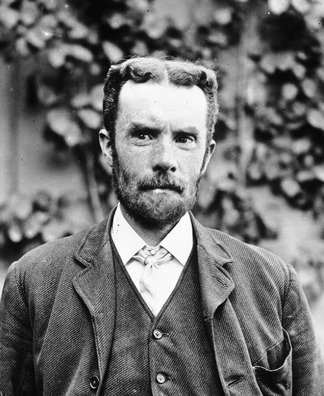
Oliver Heaviside
1850–1925 · Camden Town · Newcastle · Torquay
He left school at sixteen and worked alone at a table in his parents’ house, and the four equations in your chapter are his rewriting, not Maxwell’s.
Heaviside was born in 1850 in a poor part of Camden Town, the youngest of four sons of a wood-engraver. Scarlet fever in childhood left him partially deaf, which cut him off from other children and later from the ordinary routes into a scientific career. He did well at school even so, placed fifth of some five hundred candidates in the College of Preceptors examination of 1865, and left at sixteen. There was no money for university and he never attended one. He taught himself Morse code, took work as a telegraph operator, and by 1868 was on the Anglo-Danish cable at Newcastle.
He resigned in 1874, aged twenty-four, and went home. For the rest of his working life he held no post, had no laboratory and no colleagues in the room, and lived on his parents’ household and, from 1882, forty pounds a year from the trade paper The Electrician, which printed his articles. Working at a table he read Maxwell’s Treatise on Electricity and Magnetism — twenty equations in twenty variables — and rewrote it. In the vector notation he and Josiah Willard Gibbs arrived at independently, the theory came down to four equations. That is the form every textbook has printed since, and the reason a student meets Maxwell’s equations in a shape Maxwell never wrote.
He also derived the telegrapher’s equations, showed that inductance added at intervals along a line would carry speech without distortion, named impedance, inductance, admittance and conductance, and in 1902 predicted the conducting layer in the upper atmosphere that reflects radio waves back to the ground. His operational calculus, which solved differential equations by treating the derivative as an algebraic symbol, was attacked by mathematicians for its lack of rigour; it was put on a firm footing later and is the ancestor of the Laplace transform. The Royal Society elected him in 1891. He died at Torquay in 1925, alone and close to poverty.
“Shall I refuse my dinner because I do not fully understand the process of digestion?”
No degree, no post, no laboratory. The notation you will use all year is his.
22
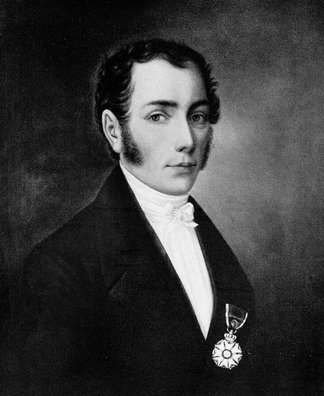
Joseph von Fraunhofer
1787–1826 · Straubing · Munich
An orphaned apprentice forbidden to read, dug out of a collapsed workshop, who mapped 574 dark lines in the spectrum of the Sun.
Fraunhofer was the eleventh child of a poor glazier in Straubing and an orphan by eleven. He was apprenticed to a Munich mirror-maker who forbade him to attend school or to read, and worked long days at the bench. In 1801 the workshop collapsed with the fourteen-year-old inside it. The rescue was watched by the Prince Elector of Bavaria, who gave the boy 200 thalers; Fraunhofer spent them on books and a glass-polishing machine, and the accident that nearly killed him is the reason he had either.
By 1806 he was at an optical institute in Benediktbeuern, and with no mathematical training to speak of he combined careful measurement with glassmaking practice. He learned to melt and mix crown and flint glass free of the streaks that ruined the lenses of the day, and by 1814 was a partner running the glassworks, making the best achromatic lenses in Europe. He kept the recipes to himself, and the institute’s objectives went to observatories across the continent.
To measure the refractive index of each new melt he needed a sharper method than coloured fringes, so he built what became the spectroscope, passing sunlight through a prism and examining it with a theodolite telescope. The continuous band of colour turned out to be crossed by hundreds of sharp dark lines. Wollaston had noticed a few in 1802; Fraunhofer measured 574 of them and labelled the strongest A to K, the letters still in use. He never learned what caused them, establishing only that they belong to the sunlight and not to our atmosphere. He died at 39 of tuberculosis, after years of breathing metal vapour in the glassworks.
“In all my experiments I could, owing to lack of time, pay attention only to those matters which appeared to have a bearing upon practical optics.”
He was not allowed to read. He ended up reading the composition of the Sun, without knowing that was what he was doing.
23
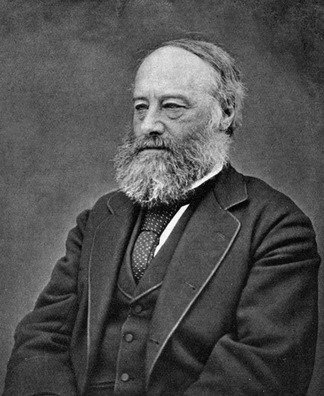
James Prescott Joule
1818–1889 · Salford · Manchester
A brewer with no university post measured how much work makes how much heat, and the Royal Society declined to publish it.
Joule managed his family's brewery in Salford and never attended a university or held an academic post. A spinal condition kept him at home as a boy, where he was tutored for a time by John Dalton, and he built a laboratory in the cellar of his own house. Everything he did in physics he did as an amateur, outside the institutions that decided what counted — a position that in the 1840s was closer to a disqualification than to a curiosity.
The consensus he was arguing against was the caloric theory, in which heat is a fluid that moves between bodies and is conserved in its own right. Joule started with electric motors, hoping to replace the brewery's steam engines, and found the heat produced tracked the electrical work put in. He moved to purely mechanical systems, and built the apparatus that made his name: a falling weight driving a paddle wheel inside an insulated barrel of water. Measuring how far the weight fell and how little the water warmed, with thermometers he made himself, gave the mechanical equivalent of heat.
The temperature rises were fractions of a degree, and that precision was exactly what made him suspect. The Royal Society's committee declined to publish his 1843 result. When he presented the paddle-wheel experiment at the British Association in Oxford in 1847 the chairman asked him to be brief and invited no discussion — except that a young William Thomson, later Lord Kelvin, saw what the numbers meant. Thomson's support carried it, and Joule's equivalence became the first law of thermodynamics.
“The grand agents of nature are indestructible.”
What you will hear that is not true
The story that Joule spent his honeymoon measuring the temperature at the top and bottom of a waterfall is half true: he and Thomson did try it in 1847, and found the water far too churned up to measure.
He was an amateur with better thermometers than the professionals, which is a kind of qualification.
24
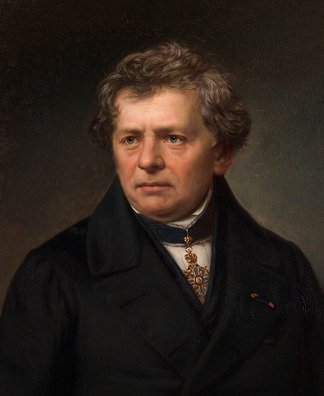
Georg Simon Ohm
1789–1854 · Erlangen · Cologne · Munich
A school physics teacher found the law relating current and voltage, was ridiculed for it, resigned, and spent six years in poverty.
Ohm was taught mathematics by his father, a self-educated locksmith in Erlangen. He could not afford to finish at the university on his first attempt, tutored in Switzerland, returned for his doctorate in 1811, and was offered only an unpaid lectureship. He took a schoolteaching post instead, ending up at a Jesuit gymnasium in Cologne, and used the school's laboratory in his own time. He was thirty-eight and a schoolmaster when he did the work he is remembered for.
The obstacle was the battery. A voltaic pile drifts as it discharges, so measurements taken over an afternoon cannot be compared with each other. Ohm replaced it with a thermocouple — a bismuth–copper junction held between boiling water and ice — which held a steady potential difference for as long as he needed, and then measured the current through wires of different lengths and thicknesses. The result was a proportionality between the potential difference across a conductor and the current through it, published in 1827 in Die galvanische Kette, mathematisch bearbeitet.
German physics at the time was dominated by a philosophical school suspicious of exactly this kind of work: measurement and formula rather than deduction from first principles. The book was attacked, and Ohm resigned his Cologne post in 1828. He spent about six years in Berlin in poverty, tutoring. Verification came from outside Germany — Pouillet in France in 1837, then the British — and the Royal Society gave him the Copley Medal in 1841. He finally got a university professorship at Munich in 1852, two years before he died.
“The circumstances in which I have hitherto lived have not been adapted to encourage me in the pursuit of novelties.”
What you will hear that is not true
The insult usually quoted — that the book was “a web of naked fancies” — is generally traced to the physicist Georg Friedrich Pohl, not to a minister of education, and the line about Ohm being unworthy to teach science has no traceable source at all.
The most-used equation in your circuits chapter cost its author his job.
25
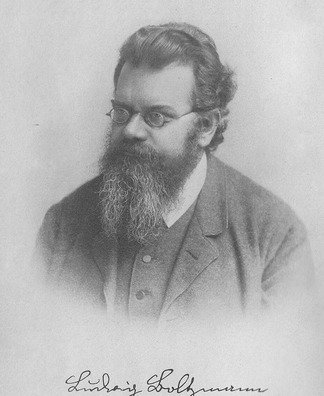
Ludwig Boltzmann
1844–1906 · Vienna · Graz · Leipzig
He built thermodynamics out of atoms while senior colleagues held that atoms were a convenient fiction, and died two years before the measurement that settled it.
Boltzmann was born in Vienna in 1844, took his doctorate there at twenty-two, and moved between chairs at Graz, Vienna, Munich and Leipzig for the rest of his life. His subject was the link between the motions of individual molecules, which nobody could see, and the quantities a thermometer or a pressure gauge can actually read. Out of it came the kinetic theory of gases in the form still taught, the distribution of molecular speeds, and the statistical reading of entropy: what a state’s entropy measures is the number of microscopic arrangements that would produce it, written S = k log W.
The difficulty was that nobody had seen an atom. An influential school of German-speaking scientists — Ernst Mach in Vienna and the chemist Wilhelm Ostwald among them — held that physics should confine itself to what can be observed, that energy alone was a sound foundation, and that molecules were a crutch to be discarded. Boltzmann argued the case for decades, in person at Lübeck in 1895 and in print against Zermelo’s objection that a mechanical system must eventually return to any state it has left. In the preface to the second part of his Lectures on Gas Theory he wrote that he expected the theory of gases to be abandoned and rediscovered later, and set the book out so that less would have to be found again.
He suffered severe swings of mood through his later years, and in September 1906, on holiday at Duino near Trieste, he killed himself. Einstein had published his account of Brownian motion the year before; between 1908 and 1909 Jean Perrin measured the jostling of suspended particles, extracted Avogadro’s number and closed the argument. Atoms were counted less than three years after the man who had insisted on them stopped. The entropy formula is carved on his gravestone in Vienna.
“I am conscious of being only an individual struggling weakly against the stream of time.”
The evidence arrives when it arrives. The argument still has to be made before it does.
26
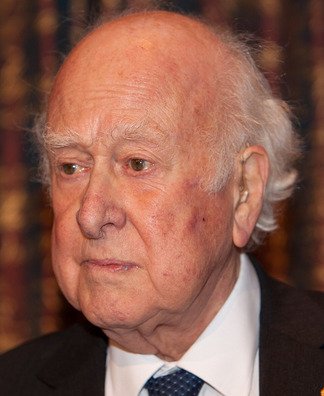
Peter Higgs
1929–2024 · Bristol · London · Edinburgh
A journal turned down the paper describing his mechanism on the ground that it had no obvious relevance to physics.
Higgs took all three of his degrees at King’s College London and moved to Edinburgh in 1960, where he stayed for the rest of his life. In the summer of 1964 he wrote two very short papers on one problem: how the carriers of a force can have mass without wrecking the symmetry of the theory that describes them. The first showed that a local symmetry provides a loophole in Goldstone’s theorem, which had appeared to forbid exactly that. Physics Letters accepted it and published it on 15 September.
The second paper set out the mechanism itself, and Physics Letters, edited at CERN, rejected it. Higgs heard at second hand that the editors had judged it of no obvious relevance to physics. He added a paragraph on what the idea might do for the strong interaction, and in doing so wrote down, in his equation (2b), the massive scalar particle that the mechanism implies. He sent the revised paper to Physical Review Letters, where it arrived on 31 August 1964, the same day that journal published François Englert and Robert Brout reaching much the same conclusion by a different route. Of the 1964 papers on the mechanism, his was the only one that mentioned the particle.
Finding it took the rest of his career. The Large Hadron Collider announced a particle of the right kind in July 2012, forty-eight years after the rejection, and the Nobel Prize went to Higgs and Englert the year after; Brout had died in 2011. Higgs published fewer than a dozen papers in his life, disliked the attention the name brought him, and said repeatedly that the mechanism belonged to several people at once. He died in Edinburgh in April 2024.
“This paragraph is perhaps why I get credited with the so-called Higgs boson.”
“There is a sort of mythology that grows up about what happened, which is different from what really did happen.”
What you will hear that is not true
The rejected paper is usually described as the one predicting the Higgs boson. It was not. The particle appears only in the paragraph he added afterwards, for a journal that had not turned him down — and by his own account that addition is why the name is his.
The paragraph that put his name on the particle was an afterthought, added because the first version had been refused.
27
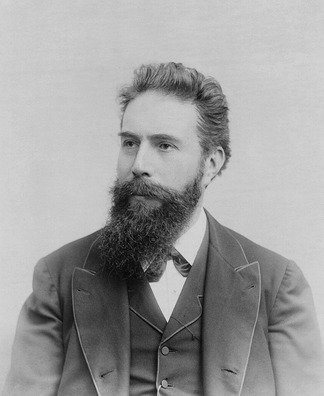
Wilhelm Conrad Röntgen
1845–1923 · Lennep · Utrecht · Zurich · Würzburg
Expelled from school for refusing to name a classmate, he was shut out of the German universities and had to be admitted on an entrance examination instead.
Expelled without a certificateBarred from matriculatingVI · Atoms →
Röntgen was born in the Rhineland in 1845, the son of a cloth merchant, and brought up in the Netherlands. At technical school in Utrecht a teacher found a caricature of himself drawn by one of the pupils. Röntgen knew who had drawn it and would not say, and he was expelled. Without a leaving certificate he could not matriculate at a Dutch or German university, which in the 1860s ended a scientific career before it began. He attended lectures at Utrecht as a visitor, with no standing and no path to a degree.
The way through was the Federal Polytechnic in Zurich, which admitted candidates on its own entrance examination rather than on a school certificate. He sat it, qualified as a mechanical engineer in 1868, took a doctorate the following year, and worked up through assistantships to chairs at Strasbourg, Giessen and finally Würzburg. On 8 November 1895, working with a discharge tube wrapped in black cardboard, he noticed a screen coated with barium platinocyanide glowing on the bench, well out of reach of anything then known.
He worked on it alone for seven weeks, photographed his wife’s hand on 22 December, and submitted the paper on 28 December, calling the unknown thing X-rays because he did not know what it was. Surgeons were using them within months. He refused to patent it, holding that it belonged to everybody, and when he received the first Nobel Prize in Physics in 1901 he gave the money to his university. He died in 1923 with his savings destroyed by wartime inflation. In German the rays still carry his name.
“I did not think, I investigated.”
“There is no history.”
The school shut him out for keeping a classmate’s secret. The one door that tested what he knew let him in.
28
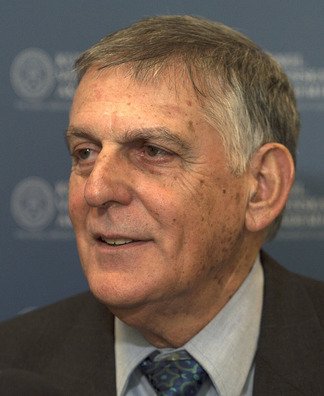
Dan Shechtman
born 1941 · Tel Aviv · Washington · Haifa
His diffraction pattern had a tenfold symmetry that crystallography said was impossible, so his group leader gave him a textbook and then asked him to leave.
Handed a textbookAsked to leave the groupVI · Atoms →
Shechtman trained as a metallurgist at the Technion in Haifa and was on sabbatical at the American National Bureau of Standards when, on 8 April 1982, he put a rapidly cooled aluminium–manganese alloy into an electron microscope and photographed how it diffracted the beam. The pattern showed ten bright points evenly spaced around a ring. A crystal was defined as a lattice repeating in three directions, and a repeating lattice can only carry two-, three-, four- or six-fold rotational symmetry; ten is not on the list. He wrote ten fold, and three question marks, in his notebook.
What came back was not argument but instruction. The head of his research group handed him a textbook on diffraction and suggested he read it, and later asked him to leave the team for bringing disgrace on it. A first paper was rejected. The result appeared in Physical Review Letters in November 1984 with Ilan Blech, Denis Gratias and John Cahn, and the loudest opposition came from Linus Pauling, twice a Nobel laureate and the most famous chemist alive, who maintained in lectures and in print that the patterns were misread twins of ordinary crystals.
The structures were real: ordered, with long-range orientational order, and never repeating — the atomic equivalent of a tiling that covers the plane without ever settling into a period. Hundreds are now known, and some occur naturally in a Siberian meteorite. In 1992 the International Union of Crystallography rewrote its definition of a crystal to admit them. Shechtman was given the Nobel Prize in 2011, alone. Pauling died in 1994, unpersuaded.
“For a long time it was me against the world.”
“There is no such thing as quasicrystals, only quasi-scientists.”
What you will hear that is not true
He is often listed among the physics laureates. The 2011 prize was in chemistry. The chapter link here is Atoms rather than Elasticity because what he actually read was a diffraction pattern.
Being handed a textbook is not an argument. Neither is being the most famous person in the room.
29
Ernest Rutherford
1871–1937 · Nelson · Montreal · Manchester · Cambridge
A flax-miller’s son from the far end of the world, one of twelve children, who arrived at Cambridge on a scholarship and found the nucleus.
One of twelve on a New Zealand farmA colonial research student at the CavendishVI · Atoms →
Rutherford was born in 1871 near Nelson, at the top of New Zealand’s South Island, one of twelve children of a flax-miller and a schoolteacher. He worked the family land as a boy, was a good enough student to win a scholarship to the University of New Zealand, and in 1894 won a further one that took him to the Cavendish Laboratory at Cambridge to work under J. J. Thomson. He arrived as a colonial research student in the best physics laboratory in the world, with no connections in it.
At McGill in Montreal he showed that radioactivity is the transmutation of one element into another and that each species decays with its own half-life; that work took the Nobel Prize in Chemistry in 1908. He moved to Manchester in 1907, and two years later Hans Geiger and Ernest Marsden, on his instruction, fired alpha particles at a thin gold foil and found that about one in eight thousand came back towards the source. Thomson’s atom, a diffuse pudding of positive charge with electrons stuck in it, could not turn anything that hard. Rutherford worked on the problem for more than a year and published in May 1911: almost all the mass and all the positive charge sit in a nucleus a minute fraction of the atom’s size.
He returned to the Cavendish as its director in 1919, split the nitrogen nucleus with alpha particles, named the proton, predicted the neutron that Chadwick found in 1932, and trained a generation — Chadwick, Bohr, Hahn, Blackett, Kapitza — that amounts to most of early nuclear physics. He died in 1937 and is buried in Westminster Abbey, near Newton.
“It was almost as incredible as if you fired a 15-inch shell at a piece of tissue paper and it came back and hit you.”
What you will hear that is not true
That quotation is genuine and it is almost always printed as though he said it in 1909. He said it in 1936, twenty-seven years afterwards, and he had told the story differently before — at Nelson in 1925 it was a gunner, a single sheet of paper and a shell that bounded back. The other line attached to him, that on hearing of his scholarship he said it was the last potato he would ever dig, is given even by the American Physical Society as something he is reported to have said. No contemporary source for it has been produced.
The most quoted sentence in your Atoms chapter is a memory twenty-seven years old. The scattering counts are not.
30
Christian Doppler
1803–1853 · Salzburg · Prague · Vienna
He got the principle right and its application wrong, and the principle has outlived the error by nearly two centuries.
Years as an assistant with no chairWrong about the very thing he set out to explainII · Waves and Sound →
Doppler was born in Salzburg in 1803, the son of a stonemason, and was too frail for the family trade. He studied mathematics and physics at the Polytechnic Institute in Vienna and philosophy at Salzburg, then spent years as an assistant and a schoolmaster with no prospect of a chair of his own. A professorship at the Prague Polytechnic came only in 1837, when he was thirty-four.
On 25 May 1842 he read a paper to the Royal Bohemian Society of Sciences, “On the coloured light of double stars and some other heavenly bodies”. Its principle is the one every student now learns: the frequency an observer measures depends on how fast source and observer are closing or separating, so an approaching source is shifted up and a receding one down. He set it out for sound and for light together, and he asked for it to be tested by some independent way of measuring how fast a star moves.
The test came in 1845, when Christoph Buys-Ballot put trumpeters on an open railway carriage outside Utrecht and stationed musicians with perfect pitch beside the line. The principle held for sound. What did not hold was the thing the paper had been written to explain: Doppler believed the colours of double stars were the shift itself, and they are not. Stellar speeds are thousands of times too small to move a star from white to red, and the shift shows up as displaced spectral lines instead. He also thought a confirmation would prove light to be a longitudinal wave. He got three years as first director of the new Institute of Physics in Vienna, taught Gregor Mendel there, and died of a lung disease at Venice in 1853, aged forty-nine.
Said of them — no quotation of their own is verified
“An important chapter in the history of astronomical spectroscopy opened on 25 May 1842.”
What you will hear that is not true
Textbooks that credit Doppler with explaining the colours of double stars have it backwards. That was his own application of the principle and it is wrong — the shift is far too small to change a star’s apparent colour. What the principle actually does in astronomy, measuring radial velocity from displaced spectral lines, was other people’s work built on his equation.
He was wrong about the stars and right about the waves. Only one of those is what a law is for.
That is all 30. Every name here had its dates and its quotation checked against a live source before it went up, six of them were held back for a while because the quotation would not check out, and where a famous version of a story turned out to be embroidered it is said so on the card. If a fact here is wrong, it is wrong in _gen/stories/ and gets fixed there.
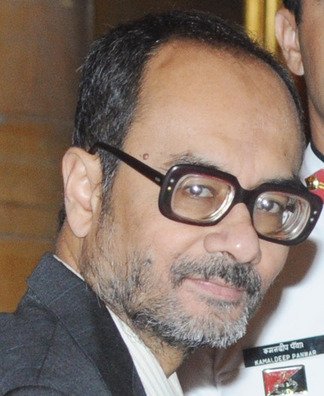
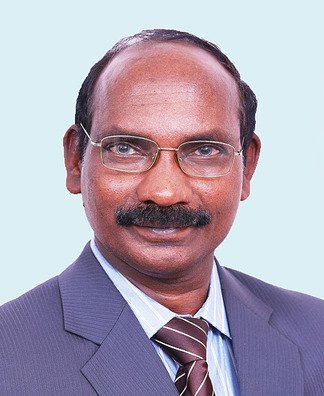
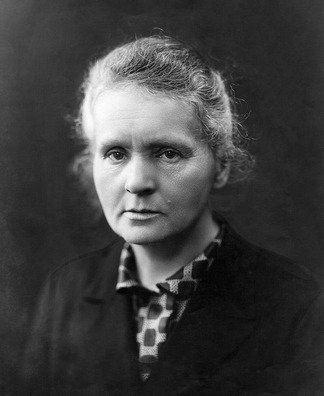
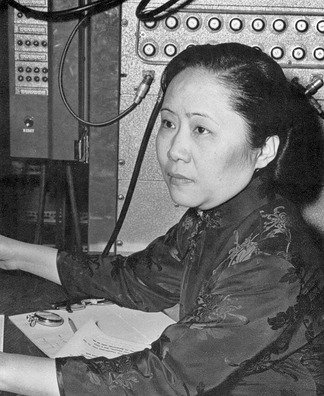
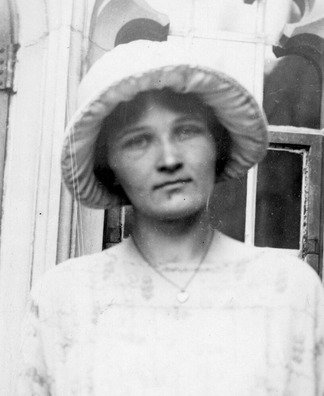
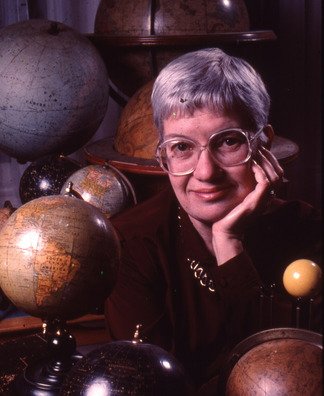
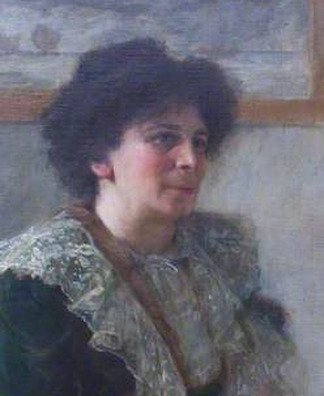
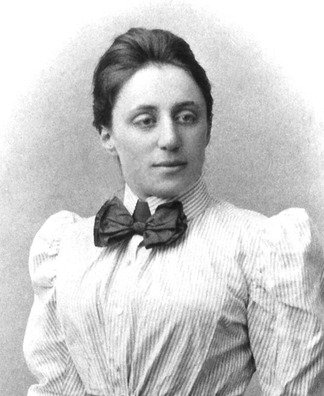
Every likeness here is a photograph or a period painting of the person named. None is drawn, generated or reconstructed. Where a portrait is a painting rather than a photograph, the credit says so.
C. V. RamanNobel Foundation · public domain
Satyendra Nath BoseUnknown author · public domain
Subrahmanyan ChandrasekharAIP Emilio Segrè Visual Archives, gift of Kameshwar Wali · attribution
Lise MeitnerHarris & Ewing · public domain
Michael FaradayUnknown author · public domain
Meghnad SahaUnknown author · public domain
Jagadish Chandra BoseBirth Centenary Committee, printed by P. C. Ray · public domain
Anna ManiOil painting by Rajasekharan Parameswaran · CC BY-SA 4.0
Bibha ChowdhuriUnknown author · public domain
E. C. G. SudarshanEmilio Segrè, courtesy AIP Emilio Segrè Visual Archives · CC BY 4.0
Abdus SalamBart Molendijk / Anefo · CC BY-SA 3.0 nl
Vainu BappuPhotographer unknown; supplied by the Indian Institute of Astrophysics · rights undetermined, fair dealing
Ashoke SenPresident’s Secretariat, India · GODL-India
K. SivanIndian Space Research Organisation · GODL-India
Marie CurieHenri Manuel · public domain
Chien-Shiung WuSmithsonian Institution · no restrictions
Cecilia Payne-GaposchkinSmithsonian Institution · no restrictions