Physics you understand
deeply enough to score.
Nothing here is asserted. Every law is derived from its first line, then built into an instrument you can drag until the number makes sense. Six Parts of the syllabus, one hub, for JEE Advanced, NEET & AP Physics (1 · 2 · C).
One hub. All of physics.
Six Parts, thirty chapters, fifty live labs — the whole syllabus, every diagram exact. Every chapter opens free and walls part-way; the pass opens the rest.
I · Mechanics
Fourteen modules from kinematics to fluids — throw the projectile, tilt the incline, race the rolling bodies, run the orbit sim.
II · Waves & Oscillations
SHM, sound & standing waves — spin the phasor, pluck the string, watch superposition build up and cancel.
III · Thermodynamics
Heat, kinetic theory, the laws & engines — squeeze the gas, drag the PV path, run the Carnot cycle in 2D & 3D.
IV · Optics
Mirrors, lenses, prisms & wave optics — drawn on the board and driven by the maths, in 2D & 3D.
V · Electromagnetism
Fields, circuits & induction — drop charges, close the loop, sweep a magnet and read the numbers as they move.
VI · Modern Physics
Quanta, atoms, nuclei and spacetime — scan a hydrogen spectrum, then work through the photoelectric effect, X-rays, semiconductors, radioactivity and relativity.
Three instruments, running on this page.
None of these is a picture. Drag the bob, aim the launcher, flip the card — the same instruments the chapters run, shrunk to fit a homepage.
Try it free. Properly.
No account and nothing to enter. Everything in this band opens today and stays open.
Work, Energy & Power — free end to end.
All twelve sections with every derivation, every worked example, the 50-question bank and the timed chapter test. Read one chapter the way all thirty are written, then decide. The other twenty-nine open free and continue behind the pass.
What the pass unlocks.
One payment for a fixed run of time. No subscription, no auto-renew, nothing to remember to cancel.
Paid once, in ₹, $, £ or €. Already bought it? Sign in from the header and every chapter opens where you left it.
Every figure is counted from the site’s own index files — the same numbers search and the banks page use. Your progress lives in your own browser either way.
Derive it, measure it, then test it.
A formula handed to you is a result you cannot check. So every law here is derived, then measured on a bench, then tested against a clock — the order physics itself works in.
Thirty chapters written out in full — every derivation from first line to last, with the assumptions stated and the sign conventions argued rather than assumed.
Then vary the parameters yourself. Sweep each law to its extremes and read off where the result holds, where it saturates and where it fails.
An untested result is an assumption. Drill the bank pattern by pattern, then sit a timed paper that reports where the marks went — which question, which step.
Where the students landed.
A selection of what students taught by Dr. Tejaswi have gone on to score — across JEE, NEET & AP Physics.
Individual student outcomes, 2021–2026. Names withheld for privacy; results depend on each student's own effort.
What students & parents say
“{{ dsOne }}”
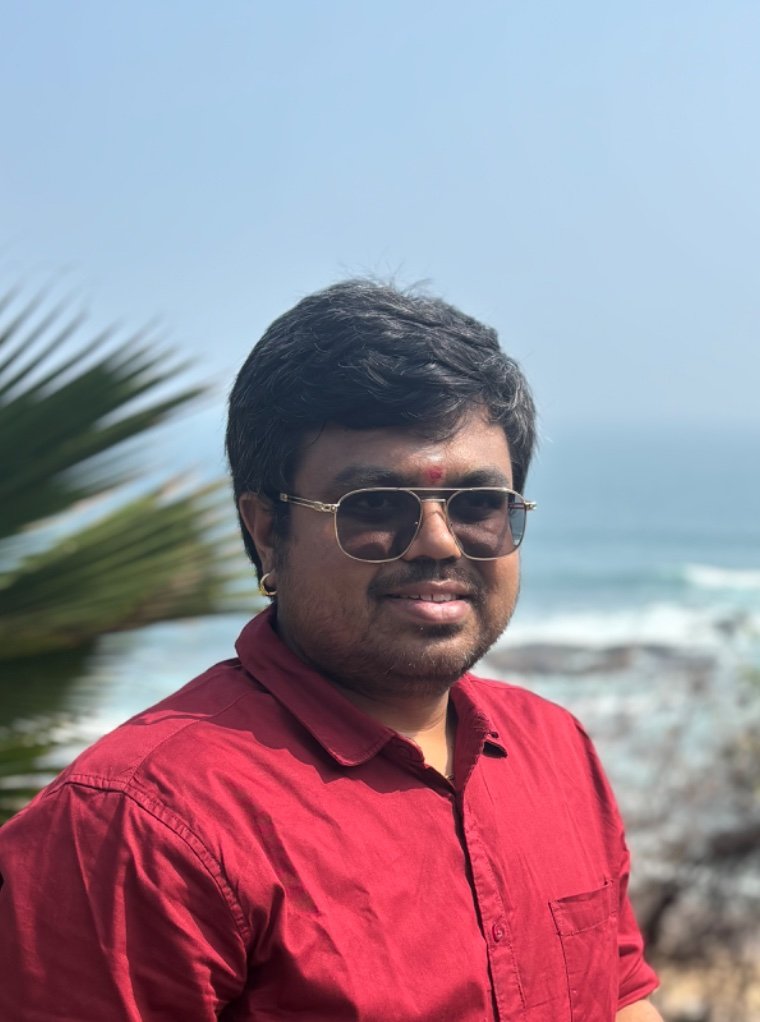
Learn it from the person who wrote it.
The site carries the reading and the drilling. An hour with him is the part a page cannot do: your own working read back to you, out loud, until the step that broke is the step you can name. Three shapes — a single hour on one blocker, a six-to-eight-week run at the paper, or the whole syllabus week by week.
Questions before you start.
Still stuck on something? Write to connect@vedatom.com — Dr. Tejaswi answers every mail himself.
What exactly is Vedatom Physics?
A written physics course that runs. Six Parts, 30 chapters, 385 reader sections — and 50 lab modules where the diagrams are live instruments you drag rather than pictures you look at.
How deep does the physics go?
Deep enough for the hardest entrance papers. Nothing is asserted: every result is derived from its first line, and each worked example closes with a check on whether the answer is physically sensible.
Is any of it free?
A good deal of it, with no account. Every chapter opens free — the opening, the first theory sections, a run of worked examples and five bank questions — and Work, Energy & Power is free end to end. So are 7 lab pages, the 120 concept traps, the 30 printable formula cards, all 100 Anvil problems with their hints and answers, 150 recall cards and three timed mock papers a day. The pass opens the rest: every section, every solution, every lab and every answer. What the pass unlocks →
Is the pass a subscription?
No. A pass is bought once for a fixed run of time — ₹3,999 for a year or ₹5,999 for two — in ₹, $, £ or €. Nothing auto-renews and there is nothing to remember to cancel. Signing in on any device opens every chapter where you left it.
Where does my progress live?
On your own device. Plans, card schedules, test marks and notes are kept in your browser, not on a server here — with or without a pass. What we do store →
Do I need an app, or an account?
Neither to begin. Every bench runs inside the page, there is nothing to install, and your progress is kept privately in your own browser rather than on our server.
Which exams is it built for?
JEE Main and Advanced, NEET, and AP Physics 1, 2 and C. Every bank question carries its pattern, so you can drill one style at a time or sit a mixed timed paper.
Who writes all of this?
Dr. Tejaswi Katravulapally — a PhD physicist who also teaches one-to-one. Every chapter, figure, bench, solution and card here was written by him; nothing is licensed in and nothing is bought in. More about him →